

2026 Digital Counties Survey Recognizes Counties Advancing Technology Leadership and Public Service
The 2026 Digital Counties Survey recognizes counties leveraging AI, data, and cybersecurity investments to strengthen government operations and advance strategic priorities.
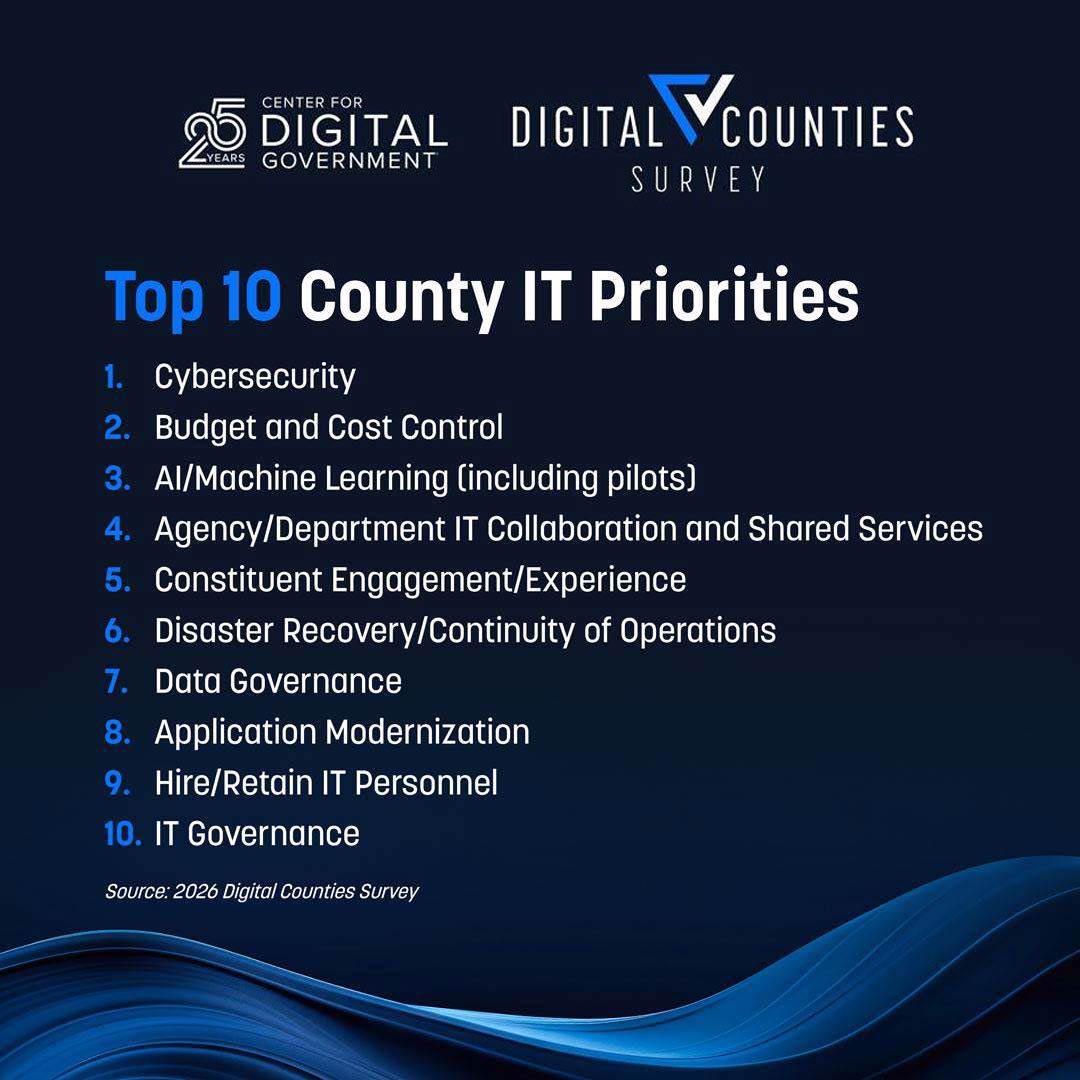
CDG's annual survey identifies national technology trends shaping county government.
Annual survey highlights counties leveraging AI, data, and cybersecurity investments to strengthen government operations and advance strategic priorities
The annual survey evaluates counties across their strengths in strategic planning, cybersecurity, digital services, organizational technology leadership, data management, and innovation. It also highlights practices that help counties strengthen performance and navigate fiscal and operational demands.
This year’s award recipients reflect a continued shift toward stronger technology governance, improved constituent experience, data-informed decision-making, workforce readiness, and the responsible adoption of emerging tools. Many first-place counties are long-time participants, underscoring how they are using sustained investment, peer benchmarking, and continuous improvement to support the maturation of their digital services and results.
"One of the clearest trends this year is that leading counties are moving beyond individual technology projects. They are connecting their investments, priorities, and building the governance, leadership, and organizational capacity needed to sustain over time,” said Rob Lloyd, Executive Director of the Center for Digital Government. “Through responsible AI, stronger data practices, and workforce investments, this year's winners are creating foundations that will help their organizations adapt and serve their communities better into the future.”
“Each year, the Digital Counties Survey highlights how counties are turning today's challenges into tomorrow's best practices,” said John Matelski, Chief Information Officer, National Association of Counties. “This awards program creates a shared body of knowledge that helps county leaders learn from one another, adapt proven approaches, and strengthen the services residents rely on every day.”
The counties earning top honors in each population category demonstrated their ability to connect technology initiatives to organizational goals, improve the resident experience in measured ways, and build resilient operations capable of supporting future ambitions.
The 2026 First-Place Award Recipients by Population Category
* Orange County, Fla. (Population of 1,000,000 or more)
Orange County is a leader in AI innovation, leveraging emerging technologies to improve public services and strengthen county operations. The county has implemented more than 600 AI-enabled or AI-related projects, including the 311 Google project and Project Overdose, which uses AI to identify dangerous drug trends. Orange County also aligns its technology strategy with broader economic development goals through AI-driven workforce training, modern infrastructure, cybersecurity, risk management and governance.
* Prince William County, Va. (Population 500,000 – 999,999)
Prince William County is setting a high standard for innovation across both internal operations and resident-facing services. The county adopted a dedicated AI security platform, implemented an AI risk management framework, and established clear guidelines for using AI to enhance service delivery. One example is PWC311, which integrates a resident portal, mobile app, call center, text messaging, and AI-powered chat and voice bots, helping reduce call-handling times to less than two minutes while improving the customer experience.
* County of Marin, Calif. (Population 250,000 – 499,999)
The County of Marin demonstrates a strong commitment to leveraging technology to advance county priorities and improve operational performance. Key initiatives include the rapid deployment of AI and Microsoft tools to process historical land records, development of the MarinData enterprise data platform, and creation of a countywide data integration pipeline. Together, these efforts provide the county’s strong foundation for data-driven decision-making while supporting transparency, efficiency, and long-term organizational goals.
* County of Pitt, N.C. (Population 150,000 – 249,999)
The County of Pitt strengthened technology leadership and AI governance through strategic organizational investments, including the creation of two Deputy CIO positions, and a partnership with a private-sector research organization. The county's 14-channel digital constituent services ecosystem is supported by a formal Key Performance Indicator (KPI) framework that tracks measurable performance improvements and helped produce double-digit growth in digital adoption. Additional innovations include a multimedia dashboard for the county's permitting system and a 12-step AI playbook designed to guide responsible implementation of emerging technologies.
* County of York, Va. (Population Less than 150,000)
The County of York developed innovative workforce planning and talent retention strategies to support long-term technology success. Initiatives include aligning IT salaries with organizational values and targets, modernizing job classifications, and offering incentives for professional certifications. The county also maintains a disciplined approach to AI governance through a specific Administrative Directive that requires every AI initiative to clearly demonstrate anticipated benefits before approval, helping ensure innovation is aligned with organizational priorities and measurable outcomes.
Full List of 2026 Digital Counties Survey Award Recipients
Population of 1,000,000 or more
1st – Orange County, Fla.
2nd – King County, Wash.
3rd – County of Alameda, Calif.
4th (tie) – County of Fairfax, Va.; Maricopa County, Ariz.
5th – Cook County, Ill.
6th – Hennepin County, Minn.
7th (tie) – Montgomery County, Md.; Wake County, N.C.
8th – Gwinnett County, Ga.
9th – Fulton County, Ga.
10th – County of Clark, Nev.
Population 500,000 – 999,999
1st – Prince William County, Va.
2nd – Westchester County, N.Y.
3rd – Utah County, Utah
4th (tie) – Macomb County, Mich.; Polk County, Fla.
5th – Snohomish County, Wash.
6th – City of Indianapolis-Marion County, Ind.
7th (tie) – Cobb County, Ga.; New Castle County, Del.
8th – County of Ventura, Calif.
9th – DeKalb County, Ga.
10th – County of DuPage, Ill.
Population 250,000 – 499,999
1st – County of Marin, Calif.
2nd – Chesterfield County, Va.
3rd – County of Hamilton, Ind.
4th (tie) – Durham County, N.C.; Union County, N.C.
5th – County of Cumberland, N.C.
6th – County of Placer, Calif.
7th – Orange County, N.Y.
8th – Sonoma County, Calif.
9th – Dutchess County, N.Y.
10th (tie) – Lane County, Ore.; Leon County, Fla.
Population 150,000 – 249,999
1st – County of Pitt, N.C.
2nd – Arlington County, Va.
3rd – County of Barnstable, Mass.
4th – Cabarrus County, N.C.
5th – Stafford County, Va.
6th – Charlotte County, Fla.
7th – Berkeley County, S.C.
8th – Orange County, N.C.
9th – County of Davidson, N.C.
Population Less than 150,000
1st – County of York, Va.
2nd – Bedford County, Va.
3rd – James City County, Va.
4th – County of Franklin, Va.
5th – Coconino County, Ariz.
6th – Calvert County, Md.
7th – Transylvania County, N.C.
8th – County of Albemarle, Va.
9th – Orange County, Va.
All recipients will be recognized during the 2026 Digital Counties Awards Dinner held in conjunction with the NACo Annual Conference in New Orleans. The annual event brings together county technology leaders and public-sector innovators from across the country to celebrate excellence in digital government and share successful approaches to addressing common challenges. Information about the Awards Program can be found at https://events.govtech.com/Digital-Counties-Survey-Awards-Event.
CDG extends its appreciation to the Digital Communities corporate partners, whose ongoing support makes the Digital Counties Survey and Awards Program possible and helps recognize the outstanding work counties do to better serve their communities through the exceptional use of technology.
Premier Program Partner: CGI
Program Partners: Accela, EY, Global Solutions Group, Google PS, Granicus, JetStream, Portage CyberTech, T-Mobile, Tyler Technologies
Survey Findings: Priorities Shaping County Technology Strategies
Beyond recognizing individual counties, the survey also identifies national technology trends shaping county government.
Top 10 County IT Priorities
1. Cybersecurity
2. Budget and Cost Control
3. AI/Machine Learning (including pilots)
4. Agency/Department IT Collaboration and Shared Services
5. Constituent Engagement/Experience
6. Disaster Recovery/Continuity of Operations
7. Data Governance
8. Application Modernization
9. Hire/Retain IT Personnel
10. IT Governance
The findings reveal how counties continue to balance growing operational and budget pressures with long-term investments in cybersecurity, modernization, workforce development, and emerging technologies.
* Cybersecurity remains the top county technology priority for the 13th consecutive year
* Budget and cost control rose to the second-highest priority, reflecting continued pressure to maximize resources and demonstrate value from technology investments
* Data governance climbed from tenth to seventh place, signaling increased focus on data quality, transparency, and responsible stewardship
* 86% of counties identified funding constraints as a significant challenge over the past year
* 82 percent reported that central IT organizations or county CIOs are leading their county's approach to artificial intelligence governance, staffing, and implementation
The results point to a growing emphasis on technology leadership, organizational alignment, workforce readiness, and responsible innovation as counties work to improve service delivery, strengthen resilience, and meet evolving resident expectations.
About NACo
The National Association of Counties (NACo) strengthens America's counties, serving nearly 40,000 county elected officials and 3.6 million county employees. Founded in 1935, NACo advocates for county priorities in federal policymaking, promotes leading practices, supports professional development, and helps counties improve services for residents. Learn more at www.naco.org.
About the Center for Digital Government
The Center for Digital Government (CDG) is a national benchmarking and advisory institute focused on technology policy and best practices in state and local government. Learn more at https://www.govtech.com/cdg.
The Center for Digital Government is a trusted brand of e.Republic. Learn more at https://www.erepublic.com/.
Heidi Lorenzen
e.Republic
+1 925-353-8836
email us here
Visit us on social media:
LinkedIn
Legal Disclaimer:
EIN Presswire provides this news content "as is" without warranty of any kind. We do not accept any responsibility or liability for the accuracy, content, images, videos, licenses, completeness, legality, or reliability of the information contained in this article. If you have any complaints or copyright issues related to this article, kindly contact the author above.
